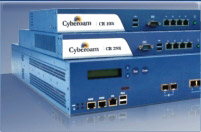
Hardware Firewall Appliance - Robust Perimeter Defense |
| |
Cyberoam’s identity-based hardware firewall appliance secures the enterprise perimeter with control over incoming and outgoing traffic. |
| |
| With Cyberoam’s powerful hardware firewall security providing access control, user authentication, network and application-level protection, enterprises operate within a highly secure network. |
| |
| Cyberoam’s enterprise-class security prevents damaging web-based attacks, allowing administrators to block or allow access based on preset user identity-based policies. Suspicious traffic is identified and blocked after inspecting networking and application information. The firewall provides secure access to public hosted servers over the Internet. |
| |
| It blocks sites and links that are known spyware, phishing, pharming generators and reduces the attack incidence, forming a powerful defense in combination with Cyberoam’s pre-integrated anti-spam solution. |
| |
| |
Cyberoam is the only UTM that embeds user identity in firewall rule matching criteria, eliminating IP addresses as intermediate components to identify and control the user. This offers instant visibility and proactive controls over security breaches. |
| |
|
| |
With Cyberoam, enterprises receive complete security in dynamic IP environments like DHCP and Wi-Fi where the user cannot be identified through IP addresses. In doing so, Cyberoam identifies the user, eliminating anonymity within network unlike IP-address based solutions. It offers a clear view of usage and threat patterns for user identity-based dynamic policy setting. |
| |
|
| |
User Identity binds the security features to create a single, consolidated Cyberoam security unit, enabling administrators to define policies across all security and productivity features over a single firewall page. |
| |
|
| |
The Cyberoam firewall analyzes packet headers and tracks packet communications over a period of time, allowing only those incoming packets that conform to the application protocol rules and user requests. |
| |
|
| |
Cyberoam examines the packet’s payload, including application data and disallows traffic that does not conform to the particular application protocol, offering dynamic packet filtering. |
| |
|
| |
The Cyberoam firewall offers protection from Denial of Service, SYN Flood, UDP, TCP, ICMP flooding attacks and from IP spoofing that generate useless, excessive traffic or reroute traffic, bringing the network to a halt. |
| |
|
| |
Dynamic network address translation enables the firewall to keep the network structure hidden from the outside world, reducing threat incidence and protecting the corporate network from unauthorized external access. In addition, it can offer internal protection, preventing unauthorized access to a particular subnet, work group or LAN within the corporate network. |
| |
|
| |
The Cyberoam firewall offers another layer of surfing security, by implementing blacklists and whitelists, allowing administrators to block or allow access based on preset user-based policies. Further, it prevents enterprise users from sending confidential information outside the network. |
| |
|
| |
Purpose-built to meet enterprise needs for the basic first line of defense, Cyberoam firewall introduces granular controls with user and group-based policies. |
| |
|
| |
Cyberoam Firewall offers auditing and inbuilt reporting capabilities with details of policy changes, network traffic and current connections. |
| |
|
| |
Cyberoam firewall comes with IPSec VPN capabilities. |
| |
|
| |
 |